Chicago Marathon 2027 Spectator Guide: Viewing Spots and Runner Meetups
Chicago Marathon spectators cannot wait at the restricted Grant Park start or finish, so the useful plan is one or two CTA-friendly course sightings followed by a specific Runner Reunite point. The 49th race is scheduled for October 10, 2027; use the runner's real pace and the final course map rather than trying to chase every tracking update.
1. Chicago Marathon 2027 spectator facts
Race date
Sunday, October 10, 2027
Start and finish
Grant Park; restricted to runners, staff and credentialed or ticketed guests
Best first-time plan
One early viewing point, one later point only if the CTA margin works, then reunion
Official reunion
Runner Reunite inside the public post-race area after it opens
Do not promise the 2026 layout as a fixed 2027 map. The event confirms the 2027 date, while detailed spectator access, CTA guidance and cheer zones will be updated nearer race week. Use the locations below as a proven planning framework, then replace mile numbers and entrances with the final guide.
2. Why the start and finish are poor spectator targets
The event's established race-day policy keeps ordinary spectators out of the start and finish areas within Grant Park. Friends cannot escort a runner to the start line or stand at the finish chute. That restriction is useful: it tells the group not to waste the early morning pressing against a closed perimeter. Say goodbye at the hotel or before the runner enters the controlled area, then walk or take CTA to a course location where spectators are permitted.
Current guidance opens the public 27th Mile Post-Race Party and Runner Reunite area later in the morning. A finished runner still needs time to receive a medal, collect gear and navigate the exit. Tracking the finish mat is not the same as seeing the person at the meetup. Build a generous buffer and choose a lettered sign, permanent landmark or exact corner inside the final official system.
Use a two-stage reunion. First choice: the official Runner Reunite letter or landmark. Second choice: a hotel lobby or named café outside the event footprint at a stated time. Everyone saves both offline.
3. Choose viewing points by purpose
🌳 Lincoln Park: energetic early sighting
The official spectator guide currently places a cheer zone around the 8K mark in Lincoln Park. This gives enough time after the start for supporters to reach the North Side while runners are still fresh. Use the final map to choose the legal side of the course and a nearby CTA station. It is a good family option because the park offers space away from the densest downtown blocks, but popular corners still fill early.
🏙️ North Wacker: central halfway atmosphere
A Bank of America cheer zone is currently listed near mile 13 on North Wacker in front of Bank of America Tower. It is convenient for Loop and River North hotels and can work as a single-viewing plan for supporters who do not want to cross the city. Tall buildings and river crossings can complicate GPS and pedestrian routes, so set a street side and landmark rather than saying only “Wacker.”
📣 Adams and Loomis: charity block party
The established Charity Block Party sits near mile 15 at Adams Street and Loomis Street by Whitney Young High School. It is valuable for charity teams and groups wanting a later West Side sighting. Check the runner's expected elapsed time and the final CTA route before leaving another location; crossing the course or relying on a bus through closures can erase the margin.
🥟 Chinatown: late-race support
Chinatown is traditionally one of the loudest late-course areas, with the Cermak-Chinatown Red Line station giving a clear transport anchor. Use the final course map for the exact street and runner direction. It pairs poorly with a last-minute dash to the finish but well with a plan to cheer once, eat nearby later and then take CTA toward the public reunion entrance.
🏁 Michigan and Roosevelt: mile 26 energy
The current official guide lists a cheer zone near mile 26 at Michigan Avenue and Roosevelt Road. It is close to the decisive final climb and Grant Park but extremely busy. Spectators are still outside the restricted finish. Choose this only when the group can arrive early, stand for a long time and accept a slower movement into Runner Reunite afterward.
4. Three plans that actually work
✅ Plan A: one sighting, then reunion
Choose Lincoln Park, North Wacker, the Charity Block Party or Chinatown based on hotel location and the runner's preference. Arrive early, remain on the agreed side and leave with enough time to enter the public post-race area. This is the most reliable first-time plan, particularly with children, older relatives or anyone needing accessible transport.
🚇 Plan B: North Side plus later course
See the runner in Lincoln Park, then use CTA—not a road bus or rideshare—to move toward Chinatown or another late point. Calculate the runner's pace, add station walking, platform crowds and a 20-minute safety margin. If the math is close, skip the second sighting and go to reunion. A supporter sprinting across stations is not helpful to the runner.
📍 Plan C: late sighting only
For a fast runner or a group staying south of the Loop, choose Chinatown or the established mile-26 area and conserve energy. This allows a relaxed morning and reduces missed connections. Tell the runner not to look for the group at several promised points; one visible sign on the correct side is more valuable than four vague plans.
5. Turn pace into arrival windows
Ask the runner for an honest target pace and likely start wave. The clock begins when the runner crosses the start, not when the elite field begins. For each viewing point, multiply the target pace by the official distance and create a window of at least 10–15 minutes on either side. Add more for a first marathon or changing weather. Write the expected local clock time beside the location.
The official app is valuable for timing splits and race information, but live maps can lag or jump. Do not leave a good spot because a dot appears briefly ahead. Trust confirmed timing mats and the planned window. Save the bib number and correct spelling before race day; the runner should not be answering “where are you?” messages while racing.
Choose the viewing side from the runner's direction. “Near the red building” is incomplete when the course fills the entire street. Send the runner a screenshot showing the course, your side and a landmark. Use a compact sign with high-contrast text, but do not block other spectators or step into the road.
6. CTA strategy and road closures
The marathon strongly encourages spectators to use public transport. Street closures and traffic make driving, parking and rideshare unreliable near the course. Buy or load the correct CTA fare before race morning, use rail for the long moves and walk from a station outside the closure footprint. A route that asks a city bus to cross the course is a warning sign.
Downtown stations have several entrances, and race barriers can close the shortest one. Save two station approaches and follow staff. Allow extra time for crowded platforms after a popular viewing point. If one member cannot use stairs, inspect the CTA's current elevator status and accessible-station map on the morning rather than assuming every Loop stop has an operating lift.
Rideshare is useful for airport arrivals, not as the main race-day plan. A driver may accept the request while being unable to reach the pin. If the group must use a car, select a pickup well outside the course, wait until closures ease and expect a higher fare. Never schedule a precise curbside pickup next to Grant Park at the runner's estimated finish.
7. Where spectators should stay
🏨 The Loop and Grant Park
Best for the runner's early entry and the post-race reunion. Palmer House, Congress Plaza, Hilton Chicago and many nearby properties create a large comparison set. Rates can be high, and “near the finish” does not grant finish-line access. The value is walking back after reunion and having several CTA lines available for spectators.
🌆 River North
River North offers restaurants, Red Line access and a central base for North Wacker or North Side movement. Compare the exact station walk and a return from Grant Park. It suits supporters who want a city weekend, but late nightlife can hurt a runner's sleep; request a quiet room and confirm bed types.
🏘️ South Loop
South Loop can balance McCormick Place expo access, Chinatown and Grant Park. Hotels around Roosevelt or near Michigan Avenue may simplify the later course and reunion. Check which streets are inside closures and do not infer that a short map distance means an easy Sunday car pickup.
🚆 Outside downtown
A lower rate in Wicker Park, Lakeview or near O'Hare can work when the hotel is genuinely close to a rail station. Add the early Sunday journey and the final post-race return to the comparison. The companion Chicago Marathon hotel guide covers runner-first choices in more detail.
8. Race-day timetable for supporters
5️⃣ Before the waves
Runner enters Grant Park with the required bib and gear. Spectators eat breakfast, check the forecast and travel directly to the first viewing area.
7️⃣ First sighting
Use the runner's actual start crossing to calculate the window. Stand on the saved side, keep the sign high only when needed and remain off the course.
9️⃣ Move or stop
Recalculate the margin. If the second location is doubtful, go to reunion instead. Tell the rest of the group rather than splitting accidentally.
🏅 Finish and reunion
Wait for exit processing, meet at the primary point, then use the backup. Carry the runner's warm layer and do not demand immediate long walks.
9. Spectator budget
This three-night budget is per spectator sharing a twin room and excludes flights. Replace hotel and airport amounts with real quotes.
Three shared hotel nights
Downtown or rail-connected neighborhood
$300–$900
Food and coffee
Three days including post-race meal
$150–$320
Airport and CTA transport
O’Hare or Midway plus race-week trips
$30–$90
Spectator supplies
Layers, sign, power bank or contingency
$25–$90
Optional activities
Architecture cruise, museum or observation deck
$40–$140
Three-night spectator ground total
Per person before flights
$545–$1,540
💡 Pro Tip: Keep runner-only costs—entry, expo purchases and race nutrition—separate from shared rooms and meals.
10. What to carry
What to Pack
- 📱Phone and power bank — Bib tracking, CTA route and reunion notes saved offline
- 🪧Compact sign — High contrast, readable, easy to carry on the train
- 🧥Weather layers — Chicago October can change during a long outdoor wait
- 🥤Water and snack — For the spectator; do not hand unauthorized food to runners
- 👟Walking shoes — Multiple stations, barriers and the final reunion
- 🧤Runner recovery layer — Carry only what the runner specifically asks for after reunion
Frequently asked questions
When is the Chicago Marathon 2027?
The 49th Bank of America Chicago Marathon is scheduled for Sunday, October 10, 2027. The event notes that future dates remain subject to change.
Can spectators see the Chicago Marathon start or finish?
The established event policy blocks ordinary spectators from the restricted start and finish areas inside Grant Park. Support from the open course, then use the official Runner Reunite area after it opens.
What are the best Chicago Marathon viewing areas?
A simple plan uses one early North Side location and one later South Side or near-finish location. Current official cheer zones include Lincoln Park around 8K, North Wacker around mile 13, Adams and Loomis around mile 15, and Michigan near Roosevelt around mile 26; confirm the 2027 map.
How do spectators get around?
Use CTA rail and walk from stations outside road closures. Driving is strongly discouraged. Save the official app and final course map, but build enough time for crowded platforms and station entrances.
Where should a spectator meet the runner?
Use the official Runner Reunite area in Grant Park, agree a letter or landmark and choose a second fallback outside the event footprint. The runner needs time to finish, collect gear and exit before meeting.
Official planning sources
- Chicago Marathon: official future event dates
- Official spectator access, cheer zones and reunion guidance
- Official transport and parking guidance
- CTA fares, routes and service alerts
Research checked October 2, 2026. Replace established course and access details with the final 2027 spectator guide and map when published.
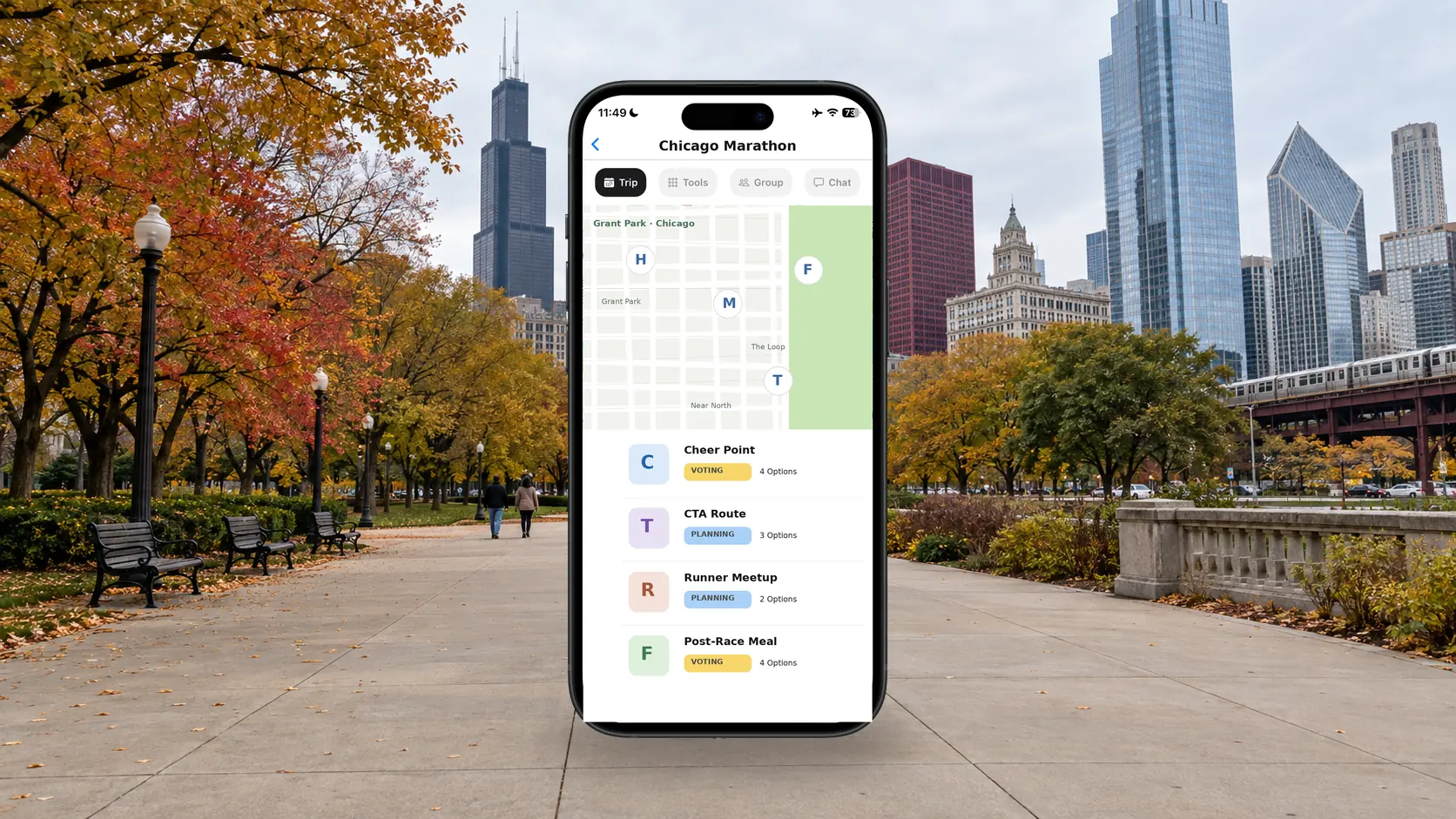
Planning with Friends? Try FlowTrip App 🚀
A marathon support crew has pace windows, viewing sides, CTA journeys and a crowded reunion to coordinate.
FlowTrip keeps the runner's bib, cheer pins, arrival windows, backup meetup and shared costs in one plan.
- 🗺️Clean Itinerary and Map overview - everyone knows where to be, no one gets lost in the chat
- 📸Build your trip by uploading Screenshots - no typing needed, just drop your restaurant reservation
- 🤖AI Trip Idea Check - validates your trip based on your preferences, destination and season
- ✨AI Recommendations - restaurants, hotels, coffee spots, activities based on your preferences
- 🗳️Polls and voting - just suggest an activity and decide together
- 💬Built-in chat - keep all trip conversations in one place
- 💰Expense tracker - split costs and track spending
- 🎒AI Packing list - never forget essentials, AI will help you to take care of it
- ☀️Weather Forecast - You will know if the weather changes